“If you love Me, keep My commandments. – John 14:15
We must not talk about our fellowship with Christ, or our being separated from the world unto Him, unless we make Him our Master and Lord in everything. Some public teachers are not true at all points to their convictions, and how can they look for a blessing? A Christian man, anxious to be useful, ought to be very particular as to every point of obedience to his Master. I have no doubt whatever that God blesses our churches even when they are very faulty, for His mercy endureth for ever. When there is a measure of error in the teaching, and a measure of mistake in the practice, He may still vouchsafe to use the ministry, for He is very gracious. But a large measure of blessing must necessarily be withheld from all teaching which is knowingly or glaringly faulty. God can set His seal upon the truth that is in it, but He cannot set His seal upon the error that is in it.
The Lord is very gracious and pitiful; but yet He is a jealous God. He is sometimes sternly jealous towards His people who are living in neglects of known duty, or in associations which are not clean in His sight. He will wither their work, weaken their strength, and humble them until at last they say, “My Lord, I will take Thy way after all. I will do what Thou biddest me to do, for else Thou wilt not accept me.” The Lord said to His disciples, “Go ye into all the world, and preach the gospel to every creature: he that believeth and is baptized shall be saved;” and He promised them that signs should follow, and so they did follow them, and so they will. But we must get back to apostolic practice and to apostolic teaching: we must lay aside the commandments of men and the whimseys of our own brains, and we must do what Christ tells us, as Christ tells us, and because Christ tells us. Definitely and distinctly, we must take the place of servants; and if we will not do that, we cannot expect our Lord to work with us and by us. Let us be determined that, as true as the needle is to the pole, so true will we be, as far as our light goes, to the command of our Lord and Master. ~ C.H. Spurgeon
https://www.blueletterbible.org/Comm/spurgeon_charles/sermons/1906.cfm
 Ezekiel 6:9 …how I have been grieved by their adulterous hearts, which have turned away from Me, and by their eyes, which have lusted after their idols. They will loathe themselves for the evil they have done and for all their detestable practices.


Christ’s birth was and is crucial. It’s the incarnation, the one-time only and only unique birth event, which the angels were celebrating. Salvation has come to the world! \o/ Did you know that the Jews of Jesus’ day did not celebrate birthdays? Not even bar/bat mitzvahs (those are new innovations)! That is why we do not see any apostle celebrating the birthday of Christ Jesus. But the Jewish-pagans of His day did celebrate birthdays – Herod was of Judaism, but he was also enamored with the Roman culture as evidenced in the celebrating of his birthday. He was a Jew in name only. He was also an Idumean, aka, an Edomite, with that wicked Haman in his ancestry.
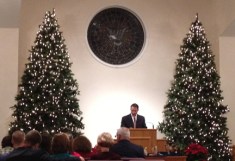
Has the Christ Mass celebration been changed from pagan to Christian lawfully? No. We do not see anywhere in Scripture where God has said to steer clear of paganism until a certain amount of time has passed. This pre-Christ yule-tide season where the decorated tree-in-house tradition comes from is, in our day, a celebration of pagan Wiccans who adopted the holiday from the sun worshiping Druids. We are to keep from even the appearance of evil, yet we look just like the Wiccans when we practice their decorated tree-in-house tradition. Putting Christ’s name on that which God hates is an evil we need to beware of if we love Christ Jesus. God warned the Israelites not to worship Him in the same manner as the heathen do their gods and we do not see a lifting of that command in the New Testament but instead see what the pagans did with their books in Acts 19:19. Its what we must do with our christo-pagan traditions and things. Hard to do? Yes! And yet easy when you love the Lord Jesus Christ and want to please Him in all of your ways.
It’s a huge error to say that the Incarnation is the Christ Mass story. It is not and never has been except it being forced upon Christ by men. I’m glad I can daily sing praises to God for sending us His Son and need no special day to reflect on it and celebrate it. And, what a burden removed by not having to observe the day as the heathen do with decorated trees and home. Set free from having to buy gifts, too. I’m also grateful that God opened my eyes to the lies of this season so that I can now worship Him in spirit and in truth.
May God open the eyes of His children and call them out of this iniquitous tradition of men/pagan/papist practice into a pure worship of Him in spirit and in truth, amen!