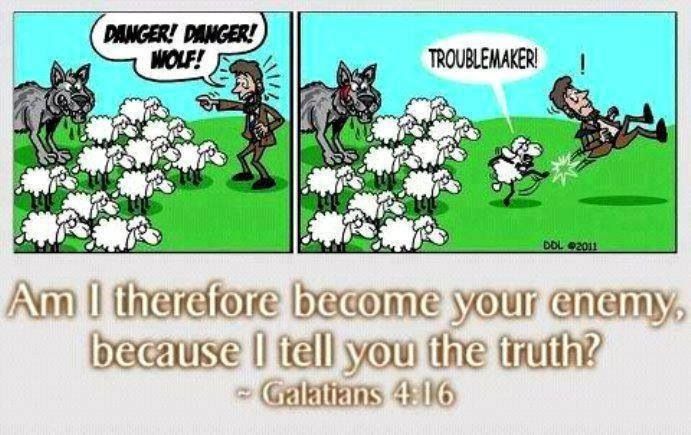
Galatians 4:16

353a97b8ad6273f8da816e204f376fef

Who is the Harlot? Feminization of the Church


Pagan Borrowing

FTA: Is Christmas in the Bible?

One of the best examples of what God thinks about humans borrowing and adapting false (pagan) customs (for holidays like Christmas) to use toward worshipping Him is in Exodus 32.

God calls Moses up the mount to receive the Ten Commandments. The children of Israel must wait at the foot of the mountain for him to return. As time passes, the Israelites grow restless. When Aaron, the High Priest, sees this he tells the people to bring him their jewelry so that he can melt it down and make them an idol (shaped like a calf) for them to worship.

God’s response to the people using pagan customs to worship him (as is done in Christmas) was swift. He did not accept Israel’s worship through the golden calf even though Aaron the High Priest was involved. His anger was kindled toward the people to the point where he was ready to destroy them all (Exodus 32:4 – 5, 7, 10)! It took the personal intervention of Moses to save the people from being completely destroyed (verses 11 – 14).

Customs used to worship false gods that are transferred to the true God, like is done with Christmas and other holiday, are unacceptable since the Bible never compromises with paganism. This is exactly the point the apostle Paul was making in 1Corinthians 10.

What then am I saying? That an idol is anything, or that which is sacrificed to an idol is anything? But that which the Gentiles sacrifice, they sacrifice to demons, and not to God; and I do not wish you to have fellowship with demons.

You cannot drink the cup of the Lord, and the cup of demons. You cannot partake of the table of the Lord, and the table of demons. Now do we provoke the Lord to jealousy? Are we stronger than He? (1Corinthians 10:19 – 22, HBFV).
The Heart is Deceitful

The heart is deceitful above all things and beyond cure. Who can understand it? – Jeremiah 17:9

Above all else, guard your heart, for everything you do flows from it. – Proverbs 4:23

Rather, clothe yourselves with the Lord Jesus Christ, and do not think about how to gratify the desires of the flesh. – Romans 13:14

Here then, is one striking evidence of the deceitfulness of the heart. It produces ignorance of ourselves; it keeps men strangers to their own character; and makes them fatally presume that they are in friendship with God, while they are enemies to Him in their minds and by wicked works. ~from THE DECEITFULNESS OF THE HEART by David Black

Foolery: Holy Water

HOLY WATER, indeed! a vile mixture, neither fit for man nor beast. You see this liquid virtue at the doors of all the churches, ready for the brows of the faithful, but what is far more curious, you observe it in little pots placed for us in the cemeteries; and that the passer-by may give the dead a showery benediction, there are little sprinkling brushes in the pots with which to scatter the precious mixture. A mother’s tears over her dead babe are far more in place than such foolery. Holy water! bah! See how the rain pours down from yonder black cloud which has passed over the rugged crags of Pilatus; that sort of holy water is infinitely more likely to moisten the clay of the defunct, and bring plenteous blessing to the living, than all the hogsheads of aqueous fluid that priests ever mumbled over. Holy water, indeed! If there be such a thing, it trickles from the eye of penitence, bedews the cheek of gratitude, and falls upon the page of holy Scripture when the word is with power. Standing where, when the rain is over, one can see the fair Lake of Lucerne brimming with crystal, and the clouds among the Alpine peaks all charged with moisture, rendered golden by the sun’s clear shining, one feels indignant at the idea that the little driblets of nastiness in yonder pots and shells should be venerated, and nature’s reservoirs accounted common or unclean. It needs no small measure of prudence to restrain a man from tumbling pots and pans and holy liquids headlong to the ground. Human folly, how far wilt thou not go when priests lead thee by the nose!

From the Note Book of my Travels. C.H.Spurgeon

— hattip: Caleb Arinaitwe.

The Evils of Ecumenism

The Mush God

An excerpt from the book, Kingdom Authority by Adrian Rogers (pp. 112-113):

God forbid that we should be ashamed of the name of Jesus in the public arena. I’ve noticed that those who lecture much about pluralism in religion really don’t mean it. If they did, they would want a Christian to pray as a Christian prays, a Jew to pray as he normally prays, and a Buddhist to pray as he normally prays. What they call “pluralism” is really synchronism–a dumbing down and melding together of all religions. Author and columnist Nicholas von Hoffmann wrote these words:

The Mush God has been known to appear to millionaires on golf courses. He appears to politicians at ribbon-cutting ceremonies and to clergymen speaking the invocation on national television at either a Democratic or Republican convention.

The Mush God has no theology to speak of, being a cream of wheat divinity. The Mush God has no particular credo, no tenets of faith, nothing that would make it difficult for a believer and non-believer alike to lower one’s head when the temporary chairman tells us that “Reverend, Rabbi, Father, Mufti, or So-And-So will lead us in an innocuous, harmless prayer.” For this god at public occasions is not a jealous god. You can invoke him to start a hookers’ convention and he/she won’t be offended.

God of the Rotary, the Optimist Club, Protector of the Buddy System, the Mush God is the Lord of the secular, ritual, of the necessary, but hypocritical forms and formalities that hush the divisive and the derisive. The Mush God is a serviceable god whose laws are chiseled, not on tablets of stone, but written on sand, open to amendment, qualification, and erasure. This is a god who will compromise with you, make allowances and declare all wars holy, all peaces hallowed.

Catholics and Evangelicals: How Different Are We?

In this message from 2008, Evangelist Mike Gendron shows us the eight major differences between Catholics:

  1. A different Authority
  2. A different Bible

  3. A different Jesus

  4. A different Gospel

  5. A different view of sin

  6. A different order of salvation

  7. A different path to eternity

  8. A different faith

With each point, Gendron explains the Catholic position, compares it to the Bible, and shows us how we as Evangelicals can respond in truth and love. Armed with knowledge and Scripture, this message equips Evangelicals to share and defend their faith when evangelizing their Catholic friends and family.