For I know this, that after my departing shall grievous wolves enter in among you, not sparing the flock. – Acts 20:29
 About A.D. 154, PoIycarp, who had observed the Passover with the apostle John and other apostles, traveled to Rome to discuss the issue of Passover and Easter with Anicetus, the bishop at Rome. At the time, neither could persuade the other to give up his custom. Wrote the fourth-century church historian Eusebius:
“For neither could Anicetus persuade Polycarp not to observe it [the Passover], because he had always observed it with John, the disciple of our Lord, and the rest of the apostles, with whom he associated; and neither did Polycarp persuade Anicetus to observe it [Passover], who said that he was bound to maintain the practice [Easter Sunday] of the presbyters before him” (Ecclesiastical History, Bk. V, Chap. XXIV).
Before Easter was universally adopted, there was a bitter and protracted controversy. In the days of Emperor Commodus (A.D. 180-192), when Victor became bishop at Rome (A.D. 190), the dispute became severe. Declared the historian Eusebius:
“There was a considerable discussion raised about this time, in consequence of a difference of opinion respecting the observance of the paschal season. The churches of all Asia, guided by a remoter tradition, supposed that they ought to keep the fourteenth day of the moon for the festival of the Saviour’s Passover, in which day the Jews were commanded to kill the paschal lamb….But…it was not the custom to celebrate it in this manner in the churches throughout the rest of the world…” (Eccl. Hist., Book. V, chap. XXIII).
Even at this late date, the Churches of YEHOVAH God in Asia dissented from the majority viewpoint. Polycrates, their leader, wrote to Victor, bishop at Rome, saying:
“We, therefore, observe the genuine day; neither adding thereto nor taking therefrom” (chap. XXIV). He cited New Testament Christians, including Philip and the apostle John and asserted: “All these observed the fourteenth day of the Passover according to the gospel deviating in no respect, but following the rule of faith” (ibid.).
Upon receiving this letter, Victor, bishop at Rome, became furious. Reports Eusebius:
“Upon this, Victor the bishop of the church of Rome, forthwith endeavoured to cut off the churches of all Asia, together with the neighbouring churches, a heterodox, from the common unity. And he published abroad by letters, and proclaims, that all the brethren there are wholly excommunicated” (ibid.).
Although at that time Victor was restrained from carrying out this threat, the controversy continued until as late as the fourth century.
By the early fourth century A.D. nominal Christianity became established as a state religion of the Roman Empire. Almost everybody sought membership in the new Church and almost nobody was rejected. Says Hurlbut of this period:
“The services of worship increased in splendor, but were less spiritual and hearty than those of former times. The forms and ceremonies of paganism gradually crept into the worship. Some of the old heathen feasts became church festivals with change of name and of worship” (ibid., p. 79).
One of those heathen feasts which were adopted by large numbers of professing Christians and endorsed by the leaders of the popular church was Easter! Roman Emperor Constantine, who had been a devoted worshipper of the sun most of his life, and who did not embrace the “Christian” religion until his death bed, proposed the adoption of pagan customs by the Christians. The church leaders of that day felt that for “Christianity” to conquer the world, it would be wise to compromise with pagans throughout the Empire. Since the common people were habituated to their pagan customs and reveled in their pagan holidays, church leaders devised a method to reconcile paganism and nominal Christianity. They simply “baptized” pagan customs, thereby making them “Christian” in appearance and name. The result? Pagans began to flock into the Church in droves. They kept the same days and performed the same rituals, but now they did it to “Christ” instead of to Astarte or Tammuz! They had not, however, understood what it meant to repent and become converted.
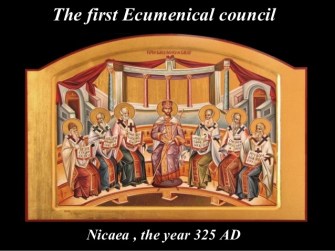
How, then, did Easter creep into the professing Christian Church? Constantine presided over the Council of Nicaea (A.D. 325) at which the “Easter question” was taken up for settlement. In an attempt to conciliate the conflicting customs of “Christians” throughout the Roman Empire, he wanted his religious leaders to determine a universal date for the celebration of Easter so that all the peoples of his Empire would observe this festival on the same date. It was at the Council of Nicaea that the date of Easter was declared to be the first Sunday after the full moon following the spring equinox.
“Well, what difference does it make?” many might ask. “Sure, Easter Sunday is derived from heathen customs, but don’t we observe it as a Christian holiday, in honor of the Messiah and his resurrection. I don’t see anything inherently wrong or evil about that!”
In the first place, Easter does not commemorate the resurrection…And second, we humans are not free to select our own method of worshipping YEHOVAH God!
King Solomon was inspired to write:
“There is a way which seemeth right unto a man, but the end thereof are the ways of death” (Proverbs 14:13; 16:25).
Yeshua the Messiah said,
“Man shall not live by bread alone, but by every word that proceedeth out of the mouth of God” (Matthew 4:4; Luke 4:4).
The vitally important question is: What does YEHOVAH say about taking pagan practices and “making them Christian”?
Jeremiah 10:2 says: “Thus saith the Lord, Learn not the way of the heathen, and be not dismayed at the signs of heaven; for the heathen are dismayed at them.”
Those are plain words.
SOURCE
 We need sweeping reformation. Let me give a definition of reformation as it is given in a religious dictionary: “Change by removal of faults or abuses, and a restoration to a former good estate.” Now that is not so bad. I do not know how anybody who believes he or she is a Christian could ever object to changing in the direction of the removal of faults and abuses toward the restoration to a former good estate. The problem is change, which disturbs many people. They have accepted the status quo as being the very tablets given by God on the mountain. Most people, if they happen to be in any church anywhere, accept the status quo without knowing or caring to inquire how it came to be. In other words, they do not ask, “Oh God, is this of You, is this divine, is this out of the Bible?” Because it was done and is being done, and because a lot of people are doing it, they assume it is all right. Then songs are written about it, and it gets into magazines. Pretty soon people are called to it, and the first thing we know we have gotten into a religious situation that is not of God. It is not according to Scripture, and God is not pleased with it at all. Rather, He is angry. Yet we do not know it because we do not like the word change. The change took place slowly, before we arrived on the scene, and we think because it is everywhere it is therefore right. We accept the status quo, the existing state of affairs, and say, “This is it,” forgetting that history demonstrates that religions invariably degenerate.
 The X Mass Blog