Calvin’s Quotes on Christmas

I know how difficult it is to persuade the world that God disapproves of all modes of worship not expressly sanctioned by His Word. The opposite persuasion which cleaves to them, being seated, as it were, in their very bones and marrow, is, that whatever they do has in itself a sufficient sanction, provided it exhibits some kind of zeal for the honor of God. But since God not only regards as frivolous, but also plainly abominates, whatever we undertake from zeal to His worship, if at variance with His command, what do we gain by a contrary course? The words of God are clear and distinct, “Obedience is better than sacrifice.” “In vain do they worship me, teaching for doctrines the commandments of men,” 1 Sam. 15:22; Matt. 15:9. Every addition of His word, especially in this matter, is a lie. Mere “will worship” (ethelothreeskia) is vanity [Col. 2:23]. This is the decision, and when once the judge has decided, it is no longer time to debate.[13]

In speaking of various corruptions of worship, Calvin comments:

I come now to ceremonies, which, while they ought to be grave attestations of divine worship, are rather a mere mockery of God. A new Judaism, as a substitute for that which God has distinctly abrogated, has again been reared up by means of numerous puerile extravagancies, collected from different quarters; and with these have been mixed up certain impious rites, partly borrowed from the heathen, and more adapted to some theatrical show than to the dignity of our religion. The first evil here is, that an immense number of ceremonies, which God had by his authority abrogated, once for all, have been again revived. The next evil is, that while ceremonies ought to be living exercises of piety, men are vainly occupied with numbers of them that are both frivolous and useless. But by far the most deadly evil of all is, that after men have thus mocked God with ceremonies of one kind or other, they think they have fulfilled their duty as admirably as if these ceremonies included in the whole essence of piety and divine worship.[14]

And in yet more pointed remarks, Calvin says:

The mockery which worships God with nought but external gestures and absurd human fictions, how could we, without sin, allow to pass unrebuked? We know how much he hates hypocrisy, and yet in that fictitious worship, which was everywhere in use, hypocrisy reigned. We hear how bitter the terms in which the prophets inveigh against all worship fabricated by human rashness. But a good intention, i.e., an insane license of daring whatever man pleased, was deemed the perfection of worship. For it is certain that in the whole body of worship which had been established, there was scarcely a single observance which had an authoritative sanction from the Word of God.

We are not in this matter to stand either by our own or by other men’s judgments. We must listen to the voice of God, and hear in what estimation he holds that profanation of worship which is displayed when men, overleaping the boundaries of His Word, run riot in their own inventions. The reasons which he assigns for punishing the Israelites with blindness, after they had lost the pious and holy discipline of the Church, are two, viz., the prevalence of hypocrisy, and will-worship (ejqeloqrhskeiva), meaning thereby a form of worship contrived by man. “Forasmuch,” says he, “as the people draw near me with their mouth, and with the lips do honor me, but have removed their heart far from me, and their fear toward me is taught by the precept of men; therefore I will proceed to do a marvellous work among this people, even a marvellous work and a wonder: for the wisdom of their wise men shall perish, and the understanding of their prudent men shall be hid,” Isa. 29:13-14. When God stirred us up, a similar or worse perversity openly domineered throughout the Church. While God, then, was thundering from heaven, were we to sit quiet?[15]

Thus, Calvin’s writings on worship clearly enunciate the concept which has subsequently been called the regulative principle of worship: all modes of worship must be expressly sanctioned by God’s word, if they are to be considered legitimate. Since Christmas observances, and other ecclesiastical festivals, are not commanded in the scriptures, they fail to meet divine approval, even if there were no additional objections to them.
Source: http://www.swrb.com/newslett/actualNLs/Xmas_ch2.htm

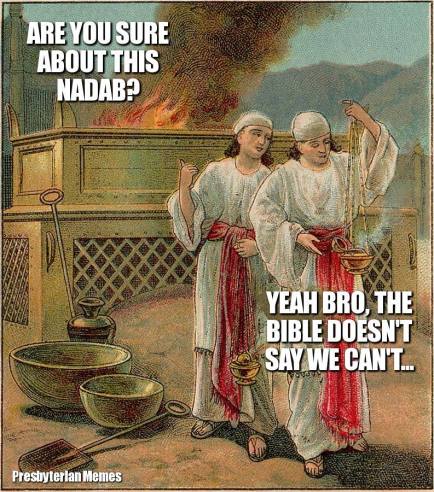
Supposing the Bible Is Silent about X Mass (although it isn’t)

14102348_1580337922269070_1447109914867527580_n

Save

Truly Think on This…

Obedience to God’s Word is not a secondary issue. If God’s Word says not to worship Him in the same manner as the heathen worship their gods, and you are making excuses, even twisting what His Word says to justify it, that is idolatry.

Deuteronomy 12:4

You must not worship the Lord your God in their way.

1 Thessalonians 5:22 (KJV)

Abstain from all appearance of evil.

Acts 15:20 GOD’S WORD® Translation

Instead, we should write a letter telling them to keep away from things polluted by false gods

1 Corinthians 10:21-22King James Version (KJV) 

Ye cannot drink the cup of the Lord, and the cup of devils: ye cannot be partakers of the Lord’s table, and of the table of devils.  Do we provoke the Lord to jealousy? are we stronger than He?

How does one worship God through disobeying Him?

Deuteronomy 12:30- Take heed to thyself that thou be not snared by following them, after that they be destroyed from before thee; and that thou enquire not after their gods, saying, How did these nations serve their gods? even so will I do likewise.

2 Corinthians 6:17- Wherefore come out from among them, and be ye separate, saith the Lord, and touch not the unclean thing; and I will receive you. 


“The Greatest Forgery Lucifer Ever Made” – Leonard Ravenhill

Christmas History: Bible & Pagans – The Truth

Christmas is the Rejection of Jesus

Most Christians are willingly blind to the fact that Christmas is a pagan ritual of witchcraft that was adopted into Catholicism by wicked men who cared nothing for Biblical authority.

Overcome Paganism with Christianized Paganism? 🤨

I was listening to VCY and they defended the Christ Mass with the scripture verse: Be not overcome of evil but overcome evil with good. – Romans 12:21 Well, they almost had me there! It sure sounds like a good way to validate the Mass of Christ. Does it apply, though? Does it cancel out other scriptures that tell us not to worship God as the heathen do in worship of their gods? Does it override these scriptures? –

Deuteronomy 12:30-32 and after they have been destroyed before you, be careful not to be ensnared by inquiring about their gods, saying, “How do these nations serve their gods? We will do the same.” You must not worship the Lord your God in their way, because in worshiping their gods, they do all kinds of detestable things the Lord hates. They even burn their sons and daughters in the fire as sacrifices to their gods. See that you do all I command you; do not add to it or take away from it.

Jeremiah 10:1,2 Hear the word which the Lord speaks to you, O house of Israel. Thus says the Lord: “Do not learn the way of the Gentiles…”

Leviticus 10:10 “And that ye may put difference between holy and unholy, and between unclean and clean.”

Isaiah 5:20 “Woe unto them that call evil good, and good evil; that put darkness for light, and light for darkness; that put bitter for sweet, and sweet for bitter!”

Ephesians 5:11 Have nothing to do with the fruitless deeds of darkness but rather expose them.

That’s just a few scriptures that would have to be ignored for the Romans 12:21 verse to apply. Scripture never contradicts itself. There must be a rightly interpreted scripture verse, passage or teaching based on scripture (the whole of the Holy Bible), to show that Romans 12:21 can be used to validate the observance of the Mass of Christ. I haven’t found it yet..

The following quote, from Kevin Reed’s, The Canterbury Tales:

In a Lutheran/Anglican posture, Mr. Jordan is asserting that the church has been granted broad discretionary power to establish means of worship. This is similar to the Anabaptist notions, which allow the ‘moving of the Spirit’ to govern the present activities of the church, without any direct appeal to the law of God. In both cases, the church has the power to worship God according to the devices of men. However, the Anabaptist opts for subjectivism (due to an emphasis on individualism); the other opts for traditionalism (with an emphasis on the corporate consensus). Yet, the law of God rejects both a subjective appeal (Deut. 12:8), and an appeal to the consensus (Deut. 12:30-31). Rather, the biblical admonition directs men to the scriptural pattern of worship (Deut. 12:32).

Who can bring a clean thing out of an unclean? not one. – Job 14:4

No Wonder Satan Gets into the Saddle