An excerpt:
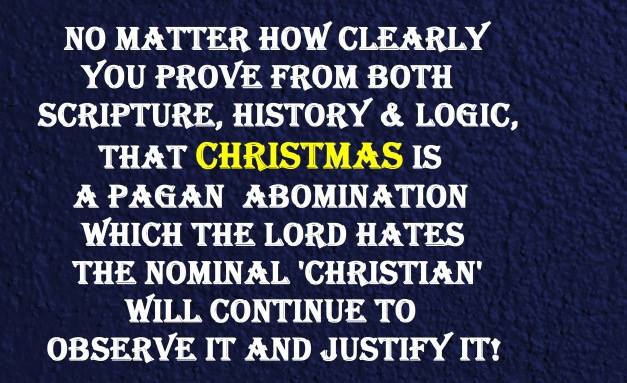
Based upon the foregoing presentation, several conclusions may be drawn. These conclusions uniformly support a complete repudiation of Christmas by those who wish to uphold a biblical view of worship.
The scriptures, both by precept and example, forbid the use of any form of worship which is not ordained by God. Since Christmas has no biblical warrant, it should be rejected, even if there were no other reason to question it. The reader who doubts this conclusion, should take a thoughtful look at scriptural passages which demonstrate the unlawfulness of adding to the worship of God through the innovations of man. (See Deut. 4:2; 12:29-32; Lev. 10:1-2; 1 Sam. 13:9-13; Col. 2:16.)
Christmas has brought an infusion of paganism into the Church. This kind of admixture was prohibited among God’s people in both the Old and New Testaments. The people of God must purge such corruptions from their midst. “What agreement hath the temple of God with idols?… Come out from among them, and be ye separate, saith the Lord, and touch not the unclean thing; and I will receive you” (2Cor. 6:16-17).
Christmas remains a monument of the superstition of the Church of Rome. If anyone doubts this proposition, he may turn on a television and watch the Papal Mass on Christmas Eve; the Pope struts around the altar, chants the prescribed words, and holds up the elements so they may be adored by a fawning multitude. This is not a light matter. It is aggravated by a modern softness toward Popery. Instead of looking for an Antichrist of the dispensational model, Protestants had better reawaken to the dangers of the Pope, who is “that Antichrist, that man of sin, and son of perdition, that exalteth himself in the church against Christ, and all that is called God. “[67] All remnants of Papal superstition must be eradicated from the Church, including favorable references to the word Christmas. The term Christmas itself lends credibility to Popery (via the Popish Mass), and God demands that his people purge even their language from the terminology of corrupt worship (see Deut. 12:3; Ex. 23:13).
Christmas observance undermines the sanctity of the Lord’s day. The yearning for festivals and celebrations among God’s people is understandable. Indeed, God instituted the Lord’s day (and the Lord’s Supper) to fulfill a need which men have in this vital area. One reason why people are so enamored with the festivity of holidays is that the Lord’s day is often perceived only in terms of what activities are prohibited on that day. If the Lord’s day is celebrated properly, with great joy, much of the desire for these other days will dissipate. We should be overjoyed with the grand truths of redemption on the day of Christ’s resurrection: “This is the day which the Lord hath made; we will rejoice and be glad in it” (Ps. 118:24). It is no mere accident of history that holidays and the Lord’s day are so often linked together in discussions of this sort. Where one is prominent, the other fades in significance. May the Lord’s day be restored to its rightful place in worship.
The institution of Christmas assumes an erroneous view of Church power. God has set apart the Lord’s day as the time for regular worship and corporate remembrance of him. Men do not have the right (or authority) to sanctify other days for stated religious observances. Christmas-keepers are thereby granting to the Church a co-equal authority with the scriptures, since they acknowledge an ecclesiastical power to institute new ordinances of worship.
Further, Christmas constitutes a false sacrament. The Old Testament ceremonies and festivals were designed to typify Christ; they were visible representations to foreshadow the Messiah who was to come, and to confirm the promises of God. Now that Christ has come, the old festivities are not to be observed. Instead, Christ has given to the Church the sacraments of baptism and the Lord’s Supper. The sacraments serve as a visible word to confirm the spiritual realities of our redemption. To celebrate Christmas in a similar manner as a visible reminder and seal of the Incarnation is to allow the holiday to usurp a role which rightly belongs to the sacraments.
Christmas is a source of great misinformation and accessory abuses. The present study has left this realm largely unexplored. Yet, it needs to be mentioned. Every year, Christmas is the occasion of serious distortions of the facts of the Incarnation. Popular presentations frequently twist the historical facts, as demonstrated by numerous portrayals of the wise men in the manger. By riding roughshod over the historical details of Christ’s birth, these popular presentations impugn the accuracy of the scriptural record.
Moreover, during the Christmas season numerous manger scenes and religious images are erected in public places, church buildings and homes. This multiplication of graven images is a blatant violation of the second commandment, which explicitly forbids making or using any pictorial representations of God. The second commandment prohibits the making of any images of God, including “pictures of Christ” in the manger.
The accessory abuses of Christmas are so commonly known, they need only be mentioned. The season is characterized by crass commercialism in the media; the stimulation of mass covetousness, especially among children; and general debauchery, as exhibited in many annual Christmas parties.
The issue is not a matter of indifference. Since Christmas was not instituted by God, it should not be approved or tolerated in the official practices of the Church.
http://www.swrb.com/newslett/actualNLs/Xmas_ch2.htm


 The X Mass Blog