Obedience in Our Worship

Blow up the trumpet in the new moon, in the time appointed, on our solemn feast day.  For this was a statute for Israel, and a law of the God of Jacob. – Psalm 81:3,4

Obedience is to direct our worship, not whim and sentiment: God’s appointments give a solemnity to rites and times which no ceremonial pomp or hierarchical ordinance could confer. The Jews not only observed the ordained month, but that part of the month which had been divinely set apart. The Lord’s people in the olden time welcomed the times appointed for worship; let us feel the same exultation, and never speak of the Sabbath (Lord’s Day) as though it could be other than a ‘delight’ and ‘honorable.’ Those who plead this passage as an authority for their man-appointed feasts and fasts must be moon-struck. We will keep such feasts as the Lord appoints, but not those which Rome or Canterbury may ordain.

“For this was a statute for Israel, and a law of the God of Jacob.” It was a precept binding upon all the tribes that a person should be set apart to commemorate the Lord’s mercy, and truly it was but the Lord’s due. He had a right and a claim to such special homage. When it can be proved that the observance of Christmas, Whitsuntide and other Popish festivals were ever instituted by a divine statute, we will also attend to them, but not till then. It is as much our duty to reject the traditions of men as to observe the ordinances of the Lord.” ~ C.H. Spurgeon

Treasury of David, Psalm 81
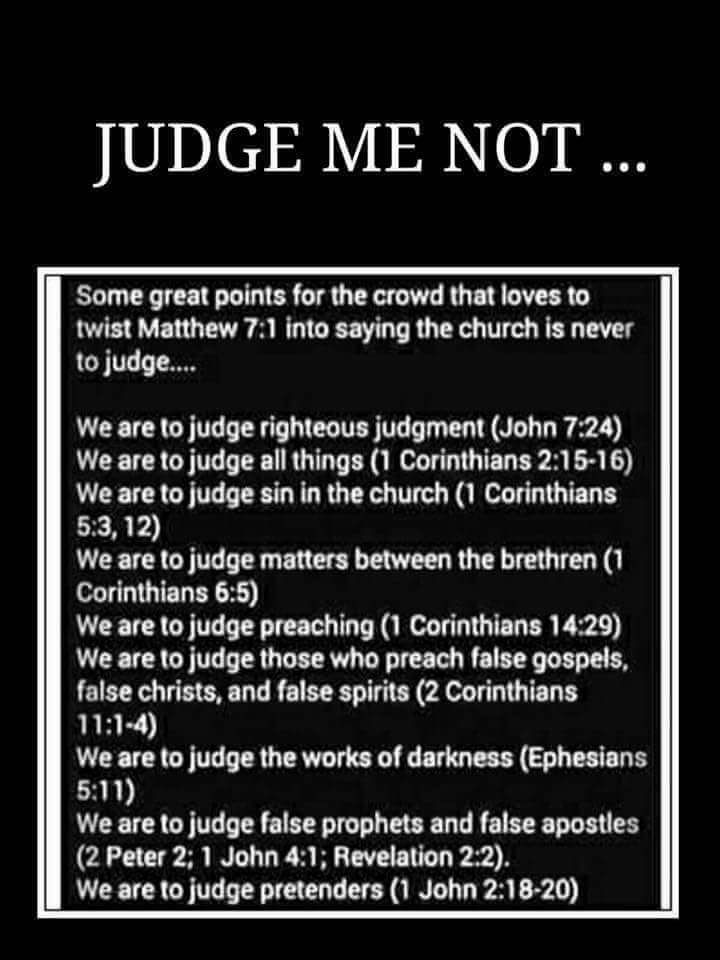
Please Don’t Twist Matthew 7…

21766503_10155762980459680_9094561823669579599_n

8 Symptoms of False Doctrine by J.C. Ryle

Many things combine to make the present inroad of false doctrine peculiarly dangerous.

1. There is an undeniable zeal in some of the teachers of error: their “earnestness” makes many think they must be right.

2. There is a great appearance of learning and theological knowledge: many fancy that such clever and intellectual men must surely be safe guides.

3. There is a general tendency to free thought and free inquiry in these latter days: many like to prove their independence of judgment, by believing novelties.

4. There is a wide-spread desire to appear charitable and liberal-minded: many seem half ashamed of saying that anybody can be in the wrong.

5. There is a quantity of half-truth taught by the modern false teachers: they are incessantly using Scriptural terms and phrases in an unscriptural sense.

6. There is a morbid craving in the public mind for a more sensuous, ceremonial, sensational, showy worship: men are impatient of inward, invisible heart-work.

7. There is a silly readiness in every direction to believe everybody who talks cleverly, lovingly and earnestly, and a determination to forget that Satan often masquerades himself “as an angel of light” (2 Corinthians 11:14).

8. There is a wide-spread “gullibility” among professing Christians: every heretic who tells his story plausibly is sure to be believed, and everybody who doubts him is called a persecutor and a narrow-minded man.

All these things are peculiar symptoms of our times. I defy any observing person to deny them. They tend to make the assaults of false doctrine in our day peculiarly dangerous. They make it more than ever needful to cry aloud, “Do not be carried away!”

Warnings to the Churches, “Divers and Strange Doctrines”, [Carlisle, PA: Banner of Truth, 1967], 76, 77.

Why is Sound Doctrine so Important?

Truth!

25 Protestations Against Christmas

By Daniel Kok.

It is difficult for people to understand why some Christians do not celebrate Christmas. I offer the following as an explanation and defense of that position so that you can understand why that is:

25 Protestations against Christmas

1. The scriptures do not inform us of the date or season of our Lord’s birth.
2. Thus all attempts to date the birth of Christ are conjecture and cannot be substantiated from scripture.
3. Although many Christians celebrate Jesus’ birth on December 25, many Eastern Christians commemorate it on January 7 instead. Yet neither date has scriptural backing. The difference between the two dates is such as the apostle Paul would say “cause(s) disputes rather than godly edification which is in faith” (1 Timothy 1:4).
4. Therefore to say, as some do, that “Christ was born this day” or “today is Jesus’ birthday” is a bearing of false witness.
5. There is no record of the subsequent celebration or commemoration of His birth in the New Testament.
6. The scriptures do not command us to observe or otherwise commend to us the celebration of Christ’s birth.
7. Most importantly, the scriptures do not give the church the authority to institute holy days, days of custom or observance for the purpose of commemorating various events in scripture. For Christ’s church is only required and allowed to do as He directs her (Matthew 28:18ff.).

continue reading here.


The Biblical Case Against Christmas – Pagan Idolatry Baptized by Catholicism

This teaching proves from the Bible that God does not accept worship that is based on a lie, that is of the world, and is mixed with heathen idolatry. We examine and refute common arguments used to justify Christmas like “Jesus knows what’s in my heart” and using Christmas to evangelize.

Copyright: © All Rights Reserved

Read article here.

Putting Christ Back in Christmas? Which Christ and has this Christ Ever Left?