Wrong Portrayal of Our Living Christ

Our Responsibility

For the X Mass Worshipers

And He said to them, “You are those who justify yourselves before men, but God knows your hearts. For what is highly esteemed among men is an abomination in the sight of God. ~Luke 16:15 NKJV 

“On that day of judgment,” says the Lord,“I will punish the leaders and princes of Judah and all those following pagan customs. ~ Zephaniah 1:8

There are many scriptures to warn against the X Mass and Easter “holy” days, and this is the weapon of our warfare. X Mass worshipers make the scriptures say what it does not, in truth, mean in order to make themselves feel good about their unholy celebration. They must make the Author’s authors complicit with christianizing paganism. We must rightly discern the scriptures and be good Bereans when confronting their version of scripture interpretation.

Some use Romans 14 to justify their supposed Christian liberty.  If the Christ Mass, or birth of Christ (which, in truth, is not what the term “Mass” really means), is to be celebrated, the apostles would be the ones to get it started. It was a few hundred years after the start of the Church when the tradition began. And it was one of the first seeker sensitive moves by the Church to bring in the unconverted pagans. There just isn’t clear thinking by the best of preachers and teachers when it comes to justifying the keeping of Christ Mass and Easter.

“For you have spent enough time in the past doing what pagans choose to do—living in debauchery, lust, drunkenness, orgies, carousing and detestable idolatry.” 1 Peter 4:3

“[T]hose who quote those portions of Scripture in opposition to the idea of a divine obligation on Christians to observe the Sabbath are found for the most part, in one section of the Church, and as members or dignitaries therein they are very far from being consistent. Their reasoning on behalf of their theory and their practice are diametrically opposed. If the Apostle Paul were permitted to revisit earth, we might imagine him addressing them somewhat after the following manner: –‘Ye men of a half-reformed Church, ye observe days and times. Ye have a whole calendar of so-called saints’ days. Ye observe a Holy Thursday and a Good Friday. Ye have a time called Easter, and a season called Lent, about which some of you make no small stir. Ye have a day regarded especially holy, named Christmas, observed at a manifestly wrong season of the year, and notoriously grafted on an old Pagan festival. And all this while many of you refuse to acknowledge the continued obligation of the Fourth Commandment. I am afraid of you, lest the instruction contained in my epistle, as well as in other parts of Scripture, has been bestowed upon you in vain.’”

–Robert Nevin (minister, Reformed Presbyterian Church in Ireland and editor of the Covenanter Magazine in Ireland), Misunderstood Scriptures (1893).

Luke 6:46 “Why do you call me, ‘Lord, Lord,’ and do not do what I say? 47 As for everyone who comes to me and hears my words and puts them into practice, I will show you what they are like. 48 They are like a man building a house, who dug down deep and laid the foundation on rock. When a flood came, the torrent struck that house but could not shake it, because it was well built. 49 But the one who hears my words and does not put them into practice is like a man who built a house on the ground without a foundation. The moment the torrent struck that house it collapsed, and its destruction was complete.”

Isaiah 42:8 “I am the Lord; that is My name!  I will not yield my glory to another or My praise to idols.

Ephesians 5:11 Have nothing to do with the fruitless deeds of darkness but rather expose them.

Whither?

An excerpt:

Based upon the foregoing presentation, several conclusions may be drawn. These conclusions uniformly support a complete repudiation of Christmas by those who wish to uphold a biblical view of worship.

The scriptures, both by precept and example, forbid the use of any form of worship which is not ordained by God. Since Christmas has no biblical warrant, it should be rejected, even if there were no other reason to question it. The reader who doubts this conclusion, should take a thoughtful look at scriptural passages which demonstrate the unlawfulness of adding to the worship of God through the innovations of man. (See Deut. 4:2; 12:29-32; Lev. 10:1-2; 1 Sam. 13:9-13; Col. 2:16.)

Christmas has brought an infusion of paganism into the Church. This kind of admixture was prohibited among God’s people in both the Old and New Testaments. The people of God must purge such corruptions from their midst. “What agreement hath the temple of God with idols?… Come out from among them, and be ye separate, saith the Lord, and touch not the unclean thing; and I will receive you” (2Cor. 6:16-17).

Christmas remains a monument of the superstition of the Church of Rome. If anyone doubts this proposition, he may turn on a television and watch the Papal Mass on Christmas Eve; the Pope struts around the altar, chants the prescribed words, and holds up the elements so they may be adored by a fawning multitude. This is not a light matter. It is aggravated by a modern softness toward Popery. Instead of looking for an Antichrist of the dispensational model, Protestants had better reawaken to the dangers of the Pope, who is “that Antichrist, that man of sin, and son of perdition, that exalteth himself in the church against Christ, and all that is called God. “[67] All remnants of Papal superstition must be eradicated from the Church, including favorable references to the word Christmas. The term Christmas itself lends credibility to Popery (via the Popish Mass), and God demands that his people purge even their language from the terminology of corrupt worship (see Deut. 12:3; Ex. 23:13).

Christmas observance undermines the sanctity of the Lord’s day. The yearning for festivals and celebrations among God’s people is understandable. Indeed, God instituted the Lord’s day (and the Lord’s Supper) to fulfill a need which men have in this vital area. One reason why people are so enamored with the festivity of holidays is that the Lord’s day is often perceived only in terms of what activities are prohibited on that day. If the Lord’s day is celebrated properly, with great joy, much of the desire for these other days will dissipate. We should be overjoyed with the grand truths of redemption on the day of Christ’s resurrection: “This is the day which the Lord hath made; we will rejoice and be glad in it” (Ps. 118:24). It is no mere accident of history that holidays and the Lord’s day are so often linked together in discussions of this sort. Where one is prominent, the other fades in significance. May the Lord’s day be restored to its rightful place in worship.

The institution of Christmas assumes an erroneous view of Church power. God has set apart the Lord’s day as the time for regular worship and corporate remembrance of him. Men do not have the right (or authority) to sanctify other days for stated religious observances. Christmas-keepers are thereby granting to the Church a co-equal authority with the scriptures, since they acknowledge an ecclesiastical power to institute new ordinances of worship.

Further, Christmas constitutes a false sacrament. The Old Testament ceremonies and festivals were designed to typify Christ; they were visible representations to foreshadow the Messiah who was to come, and to confirm the promises of God. Now that Christ has come, the old festivities are not to be observed. Instead, Christ has given to the Church the sacraments of baptism and the Lord’s Supper. The sacraments serve as a visible word to confirm the spiritual realities of our redemption. To celebrate Christmas in a similar manner ­ as a visible reminder and seal of the Incarnation ­ is to allow the holiday to usurp a role which rightly belongs to the sacraments.

Christmas is a source of great misinformation and accessory abuses. The present study has left this realm largely unexplored. Yet, it needs to be mentioned. Every year, Christmas is the occasion of serious distortions of the facts of the Incarnation. Popular presentations frequently twist the historical facts, as demonstrated by numerous portrayals of the wise men in the manger. By riding roughshod over the historical details of Christ’s birth, these popular presentations impugn the accuracy of the scriptural record.

Moreover, during the Christmas season numerous manger scenes and religious images are erected in public places, church buildings and homes. This multiplication of graven images is a blatant violation of the second commandment, which explicitly forbids making or using any pictorial representations of God. The second commandment prohibits the making of any images of God, including “pictures of Christ” in the manger.

The accessory abuses of Christmas are so commonly known, they need only be mentioned. The season is characterized by crass commercialism in the media; the stimulation of mass covetousness, especially among children; and general debauchery, as exhibited in many annual Christmas parties.

The issue is not a matter of indifference. Since Christmas was not instituted by God, it should not be approved or tolerated in the official practices of the Church.

http://www.swrb.com/newslett/actualNLs/Xmas_ch2.htm

Protestants On The Road To Rome!

This sermon (the first in this important series) exposes how some modern Protestants are leading people astray from biblical (Reformation) teaching on worship and holy days — and right into the arms of Papal Antichrist!…This message is must listening for everyone who seeks to follow the Lord, as He has revealed Himself in Scripture, in all things. Remember that the Lord Jesus Christ said in John 14:15, “If ye love me, keep my commandments,” and in Matthew 15:9, “But in vain they do worship me, teaching for doctrines the commandments of men,” — then ask yourself, “Where in Scripture is Christ-mass keeping commanded by God”?

https://www.sermonaudio.com/sermoninfo.asp?SID=1230071522288

Scroll down the page for Part 2 and other sermons on the subject.

God Will Have None of You

26733503_1690409177741334_182688682159352741_n

As Matthew Henry said, “If Satan gets but half of you, he gets all of you. If God gets but half of you, He will have none of you.” Its time to destroy all of the pagan/papist traditions and rituals from our worship to God.

Calvin’s Quotes on Christmas

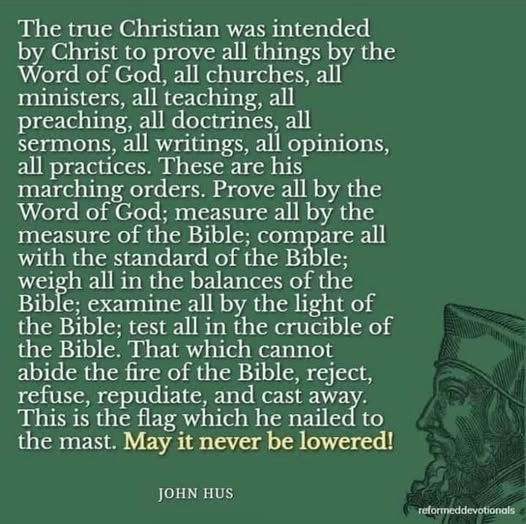
I know how difficult it is to persuade the world that God disapproves of all modes of worship not expressly sanctioned by His Word. The opposite persuasion which cleaves to them, being seated, as it were, in their very bones and marrow, is, that whatever they do has in itself a sufficient sanction, provided it exhibits some kind of zeal for the honor of God. But since God not only regards as frivolous, but also plainly abominates, whatever we undertake from zeal to His worship, if at variance with His command, what do we gain by a contrary course? The words of God are clear and distinct, “Obedience is better than sacrifice.” “In vain do they worship me, teaching for doctrines the commandments of men,” 1 Sam. 15:22; Matt. 15:9. Every addition of His word, especially in this matter, is a lie. Mere “will worship” (ethelothreeskia) is vanity [Col. 2:23]. This is the decision, and when once the judge has decided, it is no longer time to debate.[13]

In speaking of various corruptions of worship, Calvin comments:

I come now to ceremonies, which, while they ought to be grave attestations of divine worship, are rather a mere mockery of God. A new Judaism, as a substitute for that which God has distinctly abrogated, has again been reared up by means of numerous puerile extravagancies, collected from different quarters; and with these have been mixed up certain impious rites, partly borrowed from the heathen, and more adapted to some theatrical show than to the dignity of our religion. The first evil here is, that an immense number of ceremonies, which God had by his authority abrogated, once for all, have been again revived. The next evil is, that while ceremonies ought to be living exercises of piety, men are vainly occupied with numbers of them that are both frivolous and useless. But by far the most deadly evil of all is, that after men have thus mocked God with ceremonies of one kind or other, they think they have fulfilled their duty as admirably as if these ceremonies included in the whole essence of piety and divine worship.[14]

And in yet more pointed remarks, Calvin says:

The mockery which worships God with nought but external gestures and absurd human fictions, how could we, without sin, allow to pass unrebuked? We know how much he hates hypocrisy, and yet in that fictitious worship, which was everywhere in use, hypocrisy reigned. We hear how bitter the terms in which the prophets inveigh against all worship fabricated by human rashness. But a good intention, i.e., an insane license of daring whatever man pleased, was deemed the perfection of worship. For it is certain that in the whole body of worship which had been established, there was scarcely a single observance which had an authoritative sanction from the Word of God.

We are not in this matter to stand either by our own or by other men’s judgments. We must listen to the voice of God, and hear in what estimation he holds that profanation of worship which is displayed when men, overleaping the boundaries of His Word, run riot in their own inventions. The reasons which he assigns for punishing the Israelites with blindness, after they had lost the pious and holy discipline of the Church, are two, viz., the prevalence of hypocrisy, and will-worship (ejqeloqrhskeiva), meaning thereby a form of worship contrived by man. “Forasmuch,” says he, “as the people draw near me with their mouth, and with the lips do honor me, but have removed their heart far from me, and their fear toward me is taught by the precept of men; therefore I will proceed to do a marvellous work among this people, even a marvellous work and a wonder: for the wisdom of their wise men shall perish, and the understanding of their prudent men shall be hid,” Isa. 29:13-14. When God stirred us up, a similar or worse perversity openly domineered throughout the Church. While God, then, was thundering from heaven, were we to sit quiet?[15]

Thus, Calvin’s writings on worship clearly enunciate the concept which has subsequently been called the regulative principle of worship: all modes of worship must be expressly sanctioned by God’s word, if they are to be considered legitimate. Since Christmas observances, and other ecclesiastical festivals, are not commanded in the scriptures, they fail to meet divine approval, even if there were no additional objections to them.

Source: http://www.swrb.com/newslett/actualNLs/Xmas_ch2.htm
“The Greatest Forgery Lucifer Ever Made” – Leonard Ravenhill