Prevailing against the Gates of Hell?

Tom's avatarexcatholic4christ

“And Jesus answered him, “Blessed are you, Simon Bar-Jonah! For flesh and blood has not revealed this to you, but my Father who is in heaven. And I tell you, you are Peter, and on this rock I will build my church, and the gates of hell shall not prevail against it. I will give you the keys of the kingdom of heaven, and whatever you bind on earth shall be bound in heaven, and whatever you loose on earth shall be loosed in heaven.” – Matthew 16:17-19

Matthew 16:17-19 is one of the most controversial passages in the Bible. Rome bases its claims to Petrine authority primarily upon this entry. But today I would like to focus on just a small portion of the passage:

“…the gates of hell shall not prevail against (the church).” – Matthew 16:18

I listen to a lot of Catholic talk radio strictly for…

View original post 590 more words
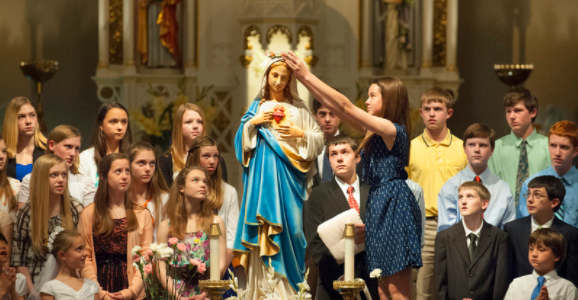
Crowning the statue of Mary on May Day

Queen of Heaven was a title given to a number of ancient sky goddesses worshipped throughout the ancient Mediterranean and Near East during ancient times. Goddesses known to have been referred to by the title include Inanna, Anat, Isis, Astarte, Hera, and possibly Asherah (by the prophet Jeremiah). In Greco-Roman times Hera, and her Roman aspect Juno bore this title. Forms and content of worship varied. In modern times, the title “Queen of Heaven” is still used by contemporary pagans to refer to the Great Goddess, while Catholics, Orthodox, and some Anglican Christians now apply the ancient title to Mary, the mother of Jesus.

https://en.wikipedia.org/wiki/Queen_of_heaven_(antiquity)

Tom's avatarexcatholic4christ

Back when I attended Catholic grammar school in the 1960s, the nuns would have all of the students assemble on the first weekday of May every year to honor the Blessed Virgin Mary. Weather permitting, the students would line up by class on a field adjoining the church, and then proceed into the church singing Ave Maria. Bringing up the rear of the procession was the May Queen and her two attendants. The nuns inevitably chose the prettiest and smartest eighth grade girl to be the May Queen. She was dressed to the nines for the occasion and carried a small crown of flowers. After she entered the church and proceeded to the small Marian altar to the right of the main altar, she placed the crown on the statue of Mary, honoring her as the Queen of Heaven.

Little did we know at the time how un-Biblical all of…

View original post 75 more words

Sacred Tradition: Roman Catholicism’s convenient “wild card”

Tom's avatarexcatholic4christ

Several months ago, I wrote a post about one of my memories of growing up within Catholicism. When I was in grammar school, the nuns would periodically go to the blackboard and draw a three-legged stool as a symbol of the Catholic church. The idea was that the church was extremely well-supported by its three pillars of guidance and authority: Holy Scripture, Sacred Tradition, and the magisterium (the pope and the bishops as teachers). All three legs were taught to be equal in authority. It was pointed out by the sisters that, in contrast, the poor Protestants had only one leg, Holy Scripture, supporting their stool, which of course made for a laughable and completely untrustworthy seating device.

In that previous post, I commented on how pope Francis’ controversial lifting of the ban on communion for remarried divorcees has exposed the baselessness of the claims regarding the divinely-led teaching authority of…

View original post 595 more words

“I never knew you…”

True Holiness and Worship

30711101_1631607336922039_4283173195546099712_n

be not like the horse or the mule

These are admonishments spoken to the regenerate, not the unregenerate…

beholdinghimministries's avatarBeholding Him Ministries

Psalm 32.8-9

I will instruct you and teach you in the way you should go;
    I will counsel you with My loving eye on you.
Do not be like the horse or the mule,
    which have no understanding
but must be controlled by bit and bridle
    or they will not come to you. Psalm 32:8-9

What a beautiful invitation from the Lord Himself to instruct and teach us in this thing called life. He promises to instruct us, direct our path, and guide us as He keeps His loving all-knowing, ever-present eye upon us. How could we ask for more…and yet we often turn down His gracious invitation.

This verse speaks of the stubbornness of man. The more I see stubbornness acted out, the more I realize that stubbornness is rooted in pride. Pride is never good. The Word plainly teaches us this truth. 1 John 2:16 comes to…

View original post 541 more words

Holiness – without it no one will see the Lord

David J. Tanner's avatarBiblical Patterns for the Christian Life

I am writing this series on holiness because I believe the whole notion of the command in Scripture to pursue holiness and its critical importance to the Christian life is not preached, taught, or emphasized sufficiently, if at all, in our churches today.  The doctrine of holiness and all it entails is one of the most essential and practical in application to the daily life of the believer.  I pray God will use this series in the life of those it touches to enrich and deepen their walk with God.

Hebrews 12:14
Pursue .. holiness, without which no one will see the Lord: 

The writer of Hebrews gives a specific, pointed, and direct command.  Pursue holiness.  The thrust is strait forward – without being holy we will not see the Lord.  This short powerful compelling verse is one that communicates a clear warning while at the same time confidence and…

View original post 3,136 more words

Should a Christian Celebrate Christmas?

Perhaps this wonderful exhaustive post read out of season may make better sense to those who are OK with mixing the holy with the profane…? I pray that it does.

Kari's avatarLet Him Hear

“Perhaps we should contemplate the words of Charles Haddon Spurgeon, delivered in a Lord’s Day sermon on December 24, 1871:

“We have no superstitious regard for times and seasons. Certainly we do not believe in the present ecclesiastical arrangement called Christmas: first, because we do not believe in the mass at all, but abhor it, whether it be said or sung in Latin or in English; and secondly, because we find no Scriptural warrant whatever for observing any day as the birthday of the Saviour; and consequently, its observance is a superstition, because [it’s] not of divine authority. Superstition has fixed most positively the day of our Saviour’s birth, although there is no possibility of discovering when it occurred. …

“It was not till the middle of the third century that any part of the church celebrated the nativity of our Lord; and it was not till very long…

View original post 11,833 more words