Wrong Portrayal of Our Living Christ

Our Responsibility

For the X Mass Worshipers

And He said to them, “You are those who justify yourselves before men, but God knows your hearts. For what is highly esteemed among men is an abomination in the sight of God. ~Luke 16:15 NKJV 

“On that day of judgment,” says the Lord,“I will punish the leaders and princes of Judah and all those following pagan customs. ~ Zephaniah 1:8

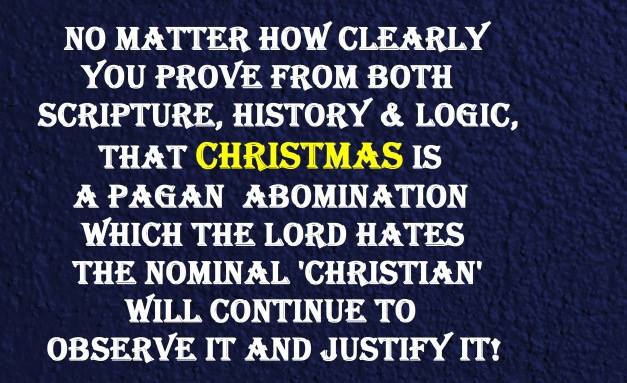
There are many scriptures to warn against the X Mass and Easter “holy” days, and this is the weapon of our warfare. X Mass worshipers make the scriptures say what it does not, in truth, mean in order to make themselves feel good about their unholy celebration. They must make the Author’s authors complicit with christianizing paganism. We must rightly discern the scriptures and be good Bereans when confronting their version of scripture interpretation.

Some use Romans 14 to justify their supposed Christian liberty.  If the Christ Mass, or birth of Christ (which, in truth, is not what the term “Mass” really means), is to be celebrated, the apostles would be the ones to get it started. It was a few hundred years after the start of the Church when the tradition began. And it was one of the first seeker sensitive moves by the Church to bring in the unconverted pagans. There just isn’t clear thinking by the best of preachers and teachers when it comes to justifying the keeping of Christ Mass and Easter.

“For you have spent enough time in the past doing what pagans choose to do—living in debauchery, lust, drunkenness, orgies, carousing and detestable idolatry.” 1 Peter 4:3

“[T]hose who quote those portions of Scripture in opposition to the idea of a divine obligation on Christians to observe the Sabbath are found for the most part, in one section of the Church, and as members or dignitaries therein they are very far from being consistent. Their reasoning on behalf of their theory and their practice are diametrically opposed. If the Apostle Paul were permitted to revisit earth, we might imagine him addressing them somewhat after the following manner: –‘Ye men of a half-reformed Church, ye observe days and times. Ye have a whole calendar of so-called saints’ days. Ye observe a Holy Thursday and a Good Friday. Ye have a time called Easter, and a season called Lent, about which some of you make no small stir. Ye have a day regarded especially holy, named Christmas, observed at a manifestly wrong season of the year, and notoriously grafted on an old Pagan festival. And all this while many of you refuse to acknowledge the continued obligation of the Fourth Commandment. I am afraid of you, lest the instruction contained in my epistle, as well as in other parts of Scripture, has been bestowed upon you in vain.’”

–Robert Nevin (minister, Reformed Presbyterian Church in Ireland and editor of the Covenanter Magazine in Ireland), Misunderstood Scriptures (1893).

Luke 6:46 “Why do you call me, ‘Lord, Lord,’ and do not do what I say? 47 As for everyone who comes to me and hears my words and puts them into practice, I will show you what they are like. 48 They are like a man building a house, who dug down deep and laid the foundation on rock. When a flood came, the torrent struck that house but could not shake it, because it was well built. 49 But the one who hears my words and does not put them into practice is like a man who built a house on the ground without a foundation. The moment the torrent struck that house it collapsed, and its destruction was complete.”

Isaiah 42:8 “I am the Lord; that is My name!  I will not yield my glory to another or My praise to idols.

Ephesians 5:11 Have nothing to do with the fruitless deeds of darkness but rather expose them.

Whither?

An excerpt:

Based upon the foregoing presentation, several conclusions may be drawn. These conclusions uniformly support a complete repudiation of Christmas by those who wish to uphold a biblical view of worship.

The scriptures, both by precept and example, forbid the use of any form of worship which is not ordained by God. Since Christmas has no biblical warrant, it should be rejected, even if there were no other reason to question it. The reader who doubts this conclusion, should take a thoughtful look at scriptural passages which demonstrate the unlawfulness of adding to the worship of God through the innovations of man. (See Deut. 4:2; 12:29-32; Lev. 10:1-2; 1 Sam. 13:9-13; Col. 2:16.)

Christmas has brought an infusion of paganism into the Church. This kind of admixture was prohibited among God’s people in both the Old and New Testaments. The people of God must purge such corruptions from their midst. “What agreement hath the temple of God with idols?… Come out from among them, and be ye separate, saith the Lord, and touch not the unclean thing; and I will receive you” (2Cor. 6:16-17).

Christmas remains a monument of the superstition of the Church of Rome. If anyone doubts this proposition, he may turn on a television and watch the Papal Mass on Christmas Eve; the Pope struts around the altar, chants the prescribed words, and holds up the elements so they may be adored by a fawning multitude. This is not a light matter. It is aggravated by a modern softness toward Popery. Instead of looking for an Antichrist of the dispensational model, Protestants had better reawaken to the dangers of the Pope, who is “that Antichrist, that man of sin, and son of perdition, that exalteth himself in the church against Christ, and all that is called God. “[67] All remnants of Papal superstition must be eradicated from the Church, including favorable references to the word Christmas. The term Christmas itself lends credibility to Popery (via the Popish Mass), and God demands that his people purge even their language from the terminology of corrupt worship (see Deut. 12:3; Ex. 23:13).

Christmas observance undermines the sanctity of the Lord’s day. The yearning for festivals and celebrations among God’s people is understandable. Indeed, God instituted the Lord’s day (and the Lord’s Supper) to fulfill a need which men have in this vital area. One reason why people are so enamored with the festivity of holidays is that the Lord’s day is often perceived only in terms of what activities are prohibited on that day. If the Lord’s day is celebrated properly, with great joy, much of the desire for these other days will dissipate. We should be overjoyed with the grand truths of redemption on the day of Christ’s resurrection: “This is the day which the Lord hath made; we will rejoice and be glad in it” (Ps. 118:24). It is no mere accident of history that holidays and the Lord’s day are so often linked together in discussions of this sort. Where one is prominent, the other fades in significance. May the Lord’s day be restored to its rightful place in worship.

The institution of Christmas assumes an erroneous view of Church power. God has set apart the Lord’s day as the time for regular worship and corporate remembrance of him. Men do not have the right (or authority) to sanctify other days for stated religious observances. Christmas-keepers are thereby granting to the Church a co-equal authority with the scriptures, since they acknowledge an ecclesiastical power to institute new ordinances of worship.

Further, Christmas constitutes a false sacrament. The Old Testament ceremonies and festivals were designed to typify Christ; they were visible representations to foreshadow the Messiah who was to come, and to confirm the promises of God. Now that Christ has come, the old festivities are not to be observed. Instead, Christ has given to the Church the sacraments of baptism and the Lord’s Supper. The sacraments serve as a visible word to confirm the spiritual realities of our redemption. To celebrate Christmas in a similar manner ­ as a visible reminder and seal of the Incarnation ­ is to allow the holiday to usurp a role which rightly belongs to the sacraments.

Christmas is a source of great misinformation and accessory abuses. The present study has left this realm largely unexplored. Yet, it needs to be mentioned. Every year, Christmas is the occasion of serious distortions of the facts of the Incarnation. Popular presentations frequently twist the historical facts, as demonstrated by numerous portrayals of the wise men in the manger. By riding roughshod over the historical details of Christ’s birth, these popular presentations impugn the accuracy of the scriptural record.

Moreover, during the Christmas season numerous manger scenes and religious images are erected in public places, church buildings and homes. This multiplication of graven images is a blatant violation of the second commandment, which explicitly forbids making or using any pictorial representations of God. The second commandment prohibits the making of any images of God, including “pictures of Christ” in the manger.

The accessory abuses of Christmas are so commonly known, they need only be mentioned. The season is characterized by crass commercialism in the media; the stimulation of mass covetousness, especially among children; and general debauchery, as exhibited in many annual Christmas parties.

The issue is not a matter of indifference. Since Christmas was not instituted by God, it should not be approved or tolerated in the official practices of the Church.

http://www.swrb.com/newslett/actualNLs/Xmas_ch2.htm

Yet We Will Continue to Warn You, Brethren

10696364_10204630268611171_1601571124060103097_nNone resist the wisdom of God more than they that should be wisest, and they resist because of their zeal for their own traditions: for men please themselves in superstition more than in any other thing, that is to say, in a worship of God fondly devised by themselves. ~ Geneva Study Bible, commentary on Mark 7:1 concerning the Pharisees (which would be today’s X Mass Worshipers who put the pagan/papist/traditions of men above God’s commandments)

THE DECEITFULNESS OF THE HEART

by David Black

Bits of copy and paste from the article which can be read in its entirety here:

“The heart is deceitful above all things,
and desperately wicked.”
Jeremiah 17:9

True and faithful is the testimony of God. Men may amuse themselves and their fellow creatures with empty, high sounding descriptions of the dignity of human nature, and the all-sufficient powers of man; but every humble, every truly enlightened mind, will see and acknowledge the justness of the declaration in the text, that the heart is deceitful above all things, and desperately wicked.

This is a truth which, like many others in the word of God, can only be learned from experience. As long as we assent to it, merely because it is contained in the Scriptures, we are strangers to its nature, and cannot understand what it means. But, as in water face answers to face, so does the heart of man to man. Human nature in different ages and in different circumstances is still the same; and when, by means of the word, the secrets of our own hearts are made manifest, when we come to perceive the exact correspondence between the declarations of Scripture, and what passes within us, we are obliged to confess, that God is in it of a truth, since none but He who searches the hearts, and tries the thoughts of men, could know so perfectly the inward workings of our minds, and those numberless evils which are hidden from the view of all our fellow creatures…

I.

The deceitfulness of the heart is evident from men’s general ignorance of their own character…

Here then, is one striking evidence of the deceitfulness of the heart. It produces ignorance of ourselves; it keeps men strangers to their own character; and makes them fatally presume that they are in friendship with God, while they are enemies to him in their minds and by wicked works.

II.

The deceitfulness of the heart appears from men’s general disposition on all occasions to justify their own conduct…

…They even learn to call their favorite vices by softer names. With them, intemperance is only the desire of good fellowship; lewdness is gallantry, or the love of pleasure; pride, a just sense of our own dignity; and covetousness, or the love of money, a prudent regard to our worldly interest. Strange infatuation! to think that by changing the names of vices, it is possible to change their nature; and that what is base and detestable in others, should be excusable only in ourselves!…

III.

That the deceitfulness of the heart appears from the difficulty with which men are brought to acknowledge their faults, even when conscious that they have done wrong…

…This necessarily follows from that disposition in human nature, to which I have already adverted, namely, the disposition on all occasions to justify our own conduct. Hence men in general are so backward to acknowledge their faults, and so displeased with those who are so faithful and friendly as to point them out. How few can bear to be told their faults! This is the sure and ready way to make most men your enemies, even though you administer the reproof in the gentlest, and most prudent manner. Instead of reflecting on their own conduct, which might convince them of the justice of what is laid to their charge, many, in these cases, set themselves immediately to discover the faults in their faithful reprovers, or in those, who, they suspect, may have informed them; and turning away their attention entirely from themselves, are only concerned to find equal, if not greater blemishes in others. Thus deceitful is the heart of man. We wish always to entertain a favorable opinion of ourselves and of our own conduct, and are displeased with those who endeavor in any instance to change this opinion, though it be done with the best, and most friendly intention…

IV.

The deceitfulness of the heart appears from the disposition which men discover to rest in mere notions and forms of religion, while they are destitute of its power…

…Hence it is that so many are hearers of the word only, and not doers also, deceiving their own selves. Hence it is that so many show great zeal about small and unimportant matters in religion, who are shamefully deficient in some of its plainest and most essential duties; that so many are punctual in their observance of religious institutions, who are unjust and uncharitable in their conduct towards their fellow creatures; that so many can talk fluently and correctly on religious subjects, who are visibly under the dominion of evil tempers or evil habits; that so many are scrupulously exact in what regards the externals of religion, who are at no pains to cultivate its genuine spirit, or to perform its most substantial duties. Like the Pharisees of old, who paid tithes of anise, mint, and cummin, they neglect the weightier matters of the law, judgment, mercy, and faith…

V.

That the deceitfulness of the heart appears in the highest degree, when men overlook the real motives of their conduct, and mistake the workings of their own corruptions, “for the fruits of the Spirit of God…

Of this we have several examples in scripture. A striking instance of it occurs in the conduct of Jehu, who, when shedding the blood of Jezreel to serve the purposes of his own ambition, said exultingly to Jehonadab, ‘Come, see my zeal for the Lord!’ It is not improbable, that at the time he imagined himself to be influenced by zeal for God, though there cannot be a doubt, that in what he did he was actuated chiefly by the ‘love of power’. Our blessed Lord forewarns his disciples, that the time would come, when whoever killed them, would think that he did God service. In like manner as the prophet Isaiah had declared concerning the persecuted people of God in his time, “Listen to what the Lord says, you that fear him and obey him: “Because you are faithful to me, some of your own people hate you and will have nothing to do with you. They mock you and say, ‘Let the Lord show his greatness and save you, so that we may see you rejoice.’ But they themselves will be disgraced!” (Isaiah 66:5)

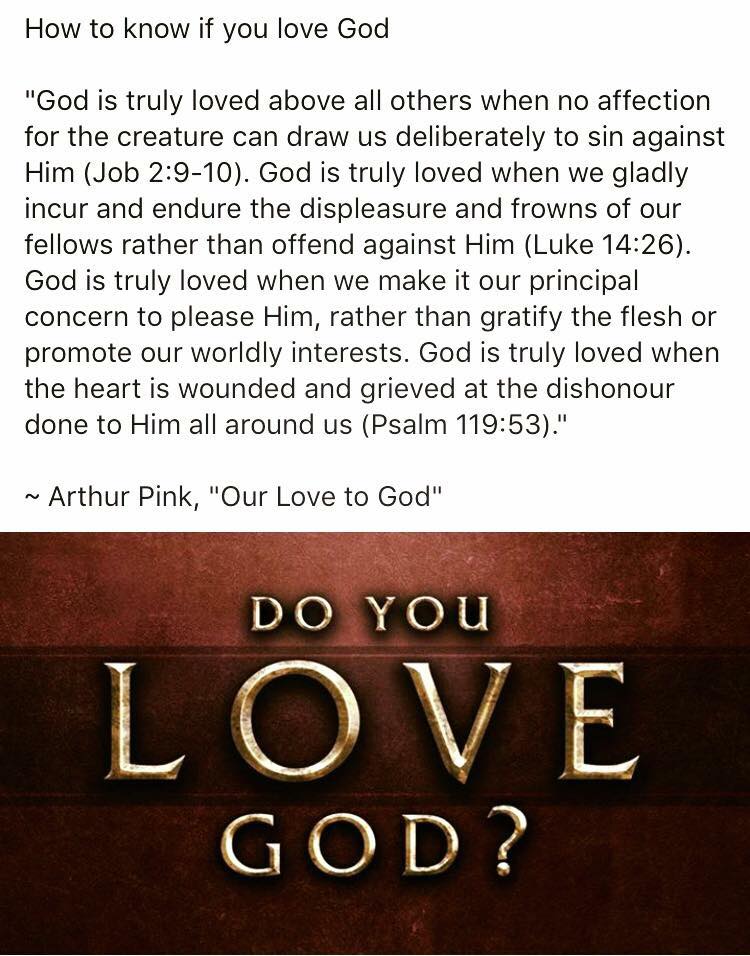
Do You Love God?

21743133_1404711812978758_6112008144784182697_n

A Separating Word

Sherry's avatarHe Hath Said

And I will put My spirit within you… – Ezekiel 36:27

Wherefore come out from among them, and be ye separate, saith the Lord, and touch not the unclean thing; and I will receive you… – 2 Corinthians 6:17

Men by nature are of another spirit from that of God, and they are under subjection to that evil spirit, the Prince of the power of the air. When the Lord comes to gather out His own, fetching them out from among the heathen, He effects the separation by doing according to this word, “I will put My spirit within you.” This done, the individual becomes a new man. Those who have the Spirit are not of the world, nor like the world; and they soon have to come out from among the ungodly, and to be separate; for difference of nature creates conflict. God’s Spirit will not dwell with the…

View original post 192 more words