Man’s Wisdom Vs. God’s Foolishness

Sherry's avatarHe Hath Said

Who changed the truth of God into a lie, and worshipped and served the creature more than the Creator, who is blessed for ever. Amen. -Romans 1:25

Look upon the heathen nations; there you see the result of wisdom’s researches. In the time of Jesus Christ, you might have beheld the earth covered with the slime of pollution, a Sodom on a large scale-corrupt, filthy, depraved; indulging in vices which we dare not mention; revelling in lust too abominable even for our imagination to dwell upon for a moment. We find the men prostrating themselves before blocks of wood and stone, adoring ten thousand gods more vicious than themselves. We find, in fact, that reason wrote out her lines with a finger covered with blood and filth, and that she forever cut herself out from all her glory by the vile deeds she did. She would not worship God. She…

View original post 116 more words

Second and Fourth Commandment: Early Church on the Lord’s Nativity and Saturnalia The Pagan Day

The first attempt at being a Seeker Sensitive Church…

mintdill's avatarMint, Anise, and the Cumin

saturnalia

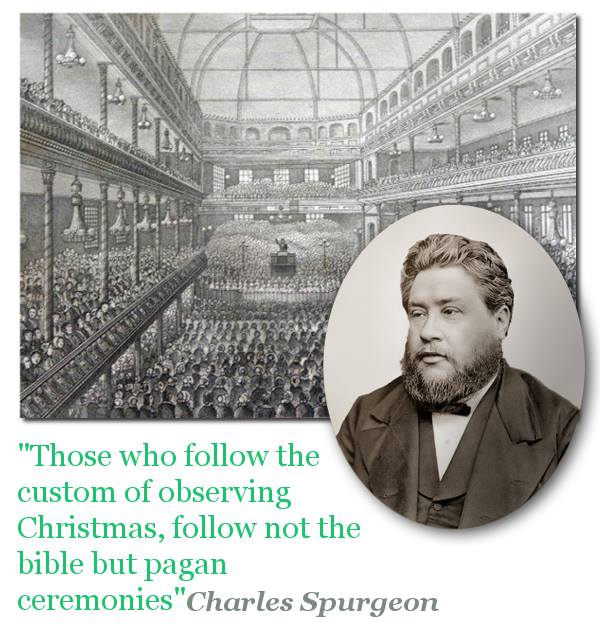
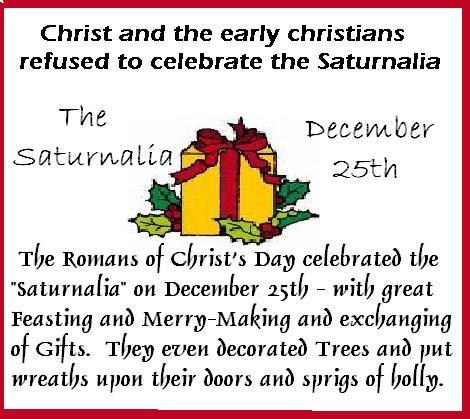
The Nativity of our Lord was not celebrated in the Early Church. In fact, the Early Church actually condemned the celebration of all birthdays as something the sinners do and what the pagans did. So why would we think that if they condemned all celebrations of birthdays that they would allow the celebration of the Lord’s Nativity? But even more so was the condemnation of paganism that was so tied to Lord’s Nativity when the Lord’s Nativity was placed on the pagan day of Saturnalia with all it’s rituals and celebratory acts.

Josephus, First Century Historian confirms that families did not celebrate birthdays:

“Nay, indeed, the law does not permit us to make festivals at the birth of our children, and thereby afford occasion of drinking to excess” (Josephus. Translated by W. Whiston. Against Apion, Book II, Chapter 26. Extracted from Josephus Complete Works, Kregel Publications, Grand Rapids (MI), 14th…

View original post 1,451 more words

It Matters to God

.

Sherry's avatarHe Hath Said

For whatsoever things were written aforetime were written for our learning, that we through patience and comfort of the scriptures might have hope. -Romans 15:4

Some people think it does not matter what doctrines you believe; that it is immaterial what church you attend; that all denominations are alike. Well, I dislike Mrs. Bigotry above almost all people in the world, and I never give her any compliment or praise; but there is another woman I hate equally as much, and that is Mrs. Latitudinarianism-a well-known character, who has made the discovery that all of us are alike. Now, I believe that a man may be saved in any church. Some have been saved in the Church of Rome-a few blessed men whose names I could mention here. I know, blessed be God, what multitudes are saved in the Church of England; she has a host of pious, praying men…

View original post 278 more words

The Blasphemous Roman Catholic Mass

Paul Flynn interviews Richard Bennett, a former Roman Catholic priest~

God Is Grieving with a Broken Heart Today

Ezekiel 6:9- And they that escape of you shall remember Me among the nations whither they shall be carried captives, because I am broken with their whorish heart, which hath departed from Me, and with their eyes, which go a whoring after their idols: and they shall lothe themselves for the evils which they have committed in all their abominations. (bold mine for emphasis)

d61561d634a14e9b64539a4991f29c21

Deuteronomy 12:30-31 “Take heed to thyself that thou be not snared by following them, after that they be destroyed from before thee; and that thou enquire not after their gods, saying, How did these nations serve their gods? even so will I do likewise.” Thou shalt not do so unto the LORD thy God: for every abomination to the LORD, which He hateth, have they done unto their gods; for even their sons and their daughters they have burnt in the fire to their gods. 32What thing soever I command you, observe to do it: thou shalt not add thereto, nor diminish from it.

1 Corinthians 10:11- Now all these things happened unto them (God’s Hebrew children) for ensamples: and they are written for our admonition, upon whom the ends of the world are come.

1 John 5:21- Little children, keep yourselves from idols. Amen. (bold mine for emphasis)

Not a Biblical Observance

12036643_10206656945136413_562975512199828505_nsaturnalia

Blasphemous Images of Christ Within Modern Evangelicalism

Making the Sign of the Cross-Witchcraft in the Roman Catholic Church

https://i0.wp.com/24.media.tumblr.com/6586d224935fa2f0303670a4c2c50ceb/tumblr_mkhtepwPQL1qgs4sno3_500.gif

From this article, False Brethren and False Principles in the Church: Spirit and Character of the Christians:

It is a curious fact that the figure of the instrument of torture on which our Lord was put to death, occupied a prominent place among the symbols of the ancient heathen worship. From the most remote antiquity the cross was venerated in Egypt and Syria; it was held in equal honour by the Buddhists of the East, [316:2] and, what is still more extraordinary, when the Spaniards first visited America, the well-known sign was found among the objects of worship in the idol temples of Anahuac. [316:3] It is also remarkable that, about the commencement of our era, the pagans were wont to make the sign of a cross upon the forehead in the celebration of some of their sacred mysteries. [317:1] A satisfactory explanation of the origin of such peculiarities in the ritual of idolatry can now scarcely be expected; but it certainly need not excite surprise if the early Christians were impressed by them, and if they viewed them as so many unintentional testimonies to the truth of their religion. The disciples displayed, indeed, no little ingenuity in their attempts to discover the figure of a cross in almost every object around them. They could recognise it in the trees and the flowers, in the fishes and the fowls, in the sails of a ship and the structure of the human body; [317:2] and if they borrowed from their heathen neighbours the custom of making a cross upon the forehead, they would of course be ready to maintain that they thus only redeemed the holy sign from profanation. Some of them were, perhaps, prepared, on prudential grounds, to plead for its introduction. Heathenism was, to a considerable extent, a religion of bowings and genuflexions; its votaries were, ever and anon, attending to some little rite or form; and, because of the multitude of these diminutive acts of outward devotion, its ceremonial was at once frivolous and burdensome. When the pagan passed into the Church, he, no doubt, often felt, for a time, the awkwardness of the change; and was frequently on the point of repeating, as it were automatically, the gestures of his old superstition. It may, therefore, have been deemed expedient to supersede more objectionable forms by something of a Christian complexion; and the use of the sign of the cross here probably presented itself as an observance equally familiar and convenient. [318:1] But the disciples would have acted more wisely had they boldly discarded all the puerilities of paganism; for credulity soon began to ascribe supernatural virtue to this vestige of the repudiated worship. As early as the beginning of the third century, it was believed to operate like a charm; and it was accordingly employed on almost all occasions by many of the Christians. “In all our travels and movements,” says a writer of this period, “as often as we come in or go out, when we put on our clothes or our shoes, when we enter the bath or sit down at table, when we light our candles, when we go to bed, or recline upon a couch, or whatever may be our employment, we mark our forehead with the sign of the cross.” [318:2]